Expertise Made Durable
Eleven years of bookseller recommendations, made searchable.
Phinney Books, Seattle · 2025–2026
See the Found at Phinney archive →
The problem with even a great newsletter
Phinney Books has sent one of the best bookstore newsletters in the country since 2014. Every other week or so: a New Book of the Week, an Old Book of the Week, a kids’ pick, and whatever else the staff has been reading, in short, opinionated reviews that make you trust the store. It’s the newsletter mine is modeled on.
An email newsletter is a fine channel and a poor archive. The back issues were online, so more than 1,200 reviews were still there, but finding one meant knowing which of three hundred newsletters to open. A recommendation from 2017 was buried inside an old issue rather than available when someone wanted that book.
Most stores that write have this problem. The expertise exists and is already written down. It isn’t findable.
What I did
I built Found at Phinney, a searchable archive of every review the newsletter has run.
The raw material was eleven years of back issues. A pipeline reads each one, finds the review blocks, and pulls out the title, author, reviewer, section, issue number, date, and the review itself. Each book is matched to an ISBN and given a cover and publisher data from Google Books where the newsletter didn’t carry its own. None of that asked anything of the store. Phinney didn’t have to sort, tag, or re-enter eleven years of old newsletters before the archive could exist; building the means to do that work was the job.
A reader can search across titles, authors, and review text, browse by the newsletter section a review ran in, or follow the store’s own floor plan: the archive splits into Made-Up and True the way the shop splits its two walls.
A Book of the Day, a Random button, and a swipe or an arrow key to move from one review to the next are there for the people who come to a bookstore to find what they weren’t looking for. Every review page names the reviewer and the issue it ran in, carries a link to the store’s Bookshop.org affiliate storefront, and asks you to subscribe. Reviews from new issues are added automatically, with no work required from the store.
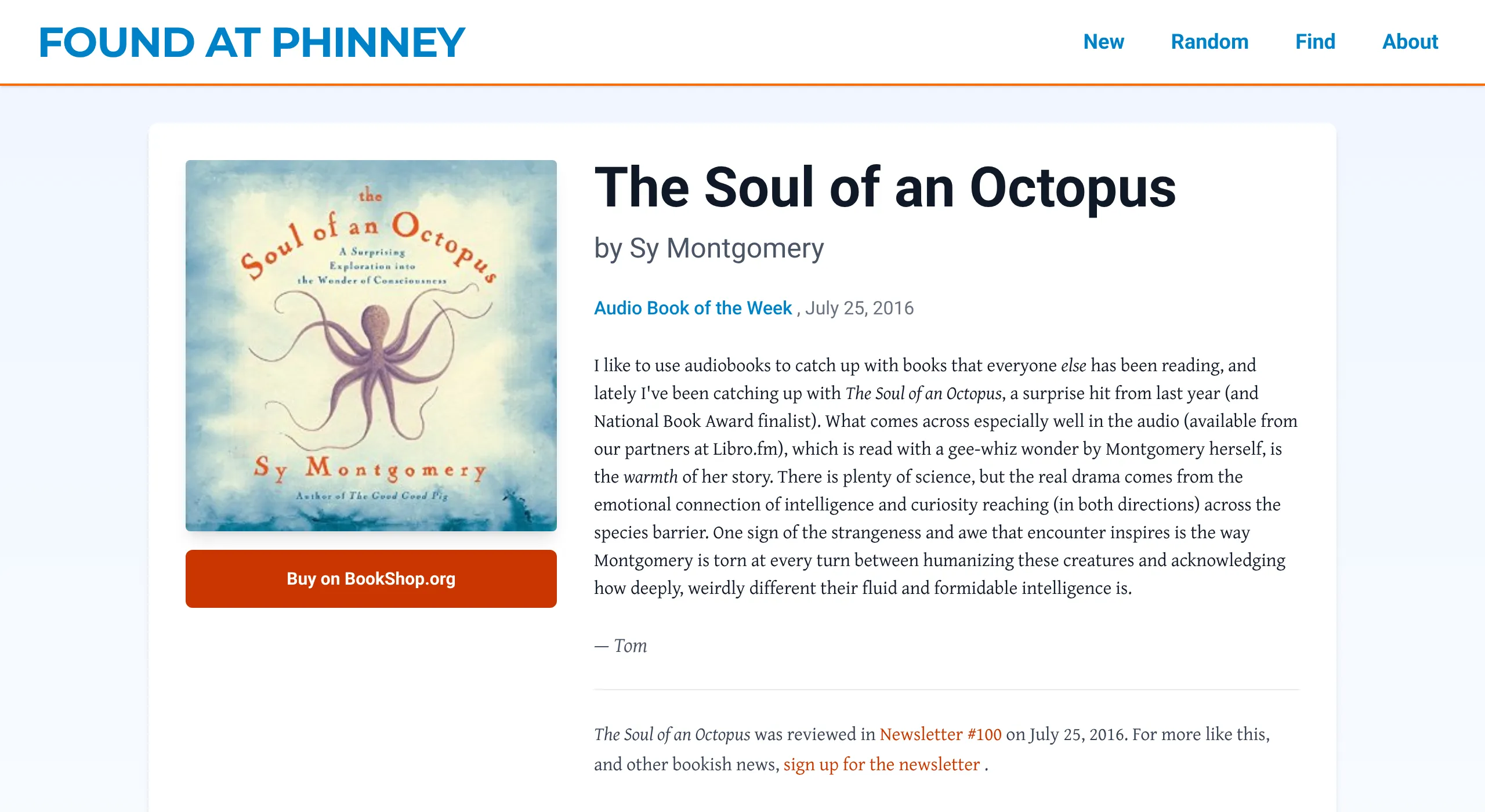
A review from July 2016, with the issue it ran in.
I built it independently, as a longtime reader of the newsletter. Phinney Books saw what it could do, and we’ve been working together to make Found at Phinney the store’s official review archive. The goal is to give the store a useful new home for its writing without adding another system for its staff to maintain.
For the technically curious: a static Astro build with Tailwind, browser-based search with Fuse.js, hosted on Vercel. No application server or database to maintain. Body text in Gentium Plus, because the reviews deserve a real typeface.
What changed
Eleven years of bookseller writing, previously buried in old newsletter issues, is now a public, searchable asset under the store’s name. A review from 2017 is as findable as last week’s, and each one sends the reader back to the store to buy the book or sign up for the newsletter.
Phinney didn’t have to migrate its newsletter or change how it publishes. New reviews appear automatically, and the archive works without adding another task to the staff’s day. The writing remains the store’s; the technology is there to make it more useful.
Traffic and referral numbers will appear here as they mature, not before.
Could I do that for you?
If your store has been writing about books for years, in a newsletter, on shelf talkers, in a blog nobody updates anymore, you already own the thing most bookstore websites lack. The work is getting it out of the format it’s stuck in and into a shape readers and search engines can use.
The Newsletter & Content Audit is where that starts: a plain account of what you’ve published and where it could live.